Quick Summary
This guide explains what a driveway gate installer does, detailing how professionals handle everything from site surveying and foundation post placement to motor mechanics and strict safety compliance. Expert authorities like ASAP Gate Repair Santa Monica illustrate the importance of precision alignment, coastal weatherproofing, and integrating certified safety sensors to ensure dependable daily operation. Property owners can use this comprehensive breakdown to evaluate project timelines and schedule a free on-site consultation with an upfront estimate for custom automated gate installation.
What Does a Driveway Gate Installer Near Me Do? Full Guide
Hiring a driveway gate installer involves more than digging post holes and hanging a gate. An installer commonly helps coordinate gate placement, motor mechanics, access features, and safety components. According to typical commercial estimates, the physical on-site build often takes one to two days, while a complete residential automated gate project can span two to four weeks depending on site surveys, fabrication, permits, and electrical coordination, though these are typical estimates rather than universal expectations.[4]
From an occupational standpoint, driveway gate installation is closely related to fence erection, which involves erecting and repairing fences and fence gates with hand and power tools. The U.S. Bureau of Labor Statistics (BLS) does not maintain a separate occupational category for driveway gate installers. For occupational context, BLS data reported 30,600 fence erectors in 2025, a median annual wage of $47,980 in May 2025, and projected employment growth of 5.6% through 2035.[2] See also Best Driveway Gate Contractors Near Me | 10% Off & Free Estimate | Same-Day Service.
What Does a Driveway Gate Installer Do? Scope and Core Responsibilities
When searching for a driveway gate installer, it helps to understand typical installation activities. Installers may evaluate property topography, set concrete footings, mount panels, and integrate motorized operators with access controls.
Key Responsibilities at a Glance
Typical gate installation activities commonly include several core stages, though BLS sources directly verify only fence and fence-gate erection and repair:[5]
- Site Measurement and Post Placement: Surveying the driveway area, evaluating alignment, excavating footings, and setting posts.
- Hardware Installation and Mechanical Alignment: Mounting hinges, tracks, guide rollers, and positive stops (for sliding gates) so the gate moves freely.
- Automation, Safety Systems, and Testing: Installing gate operators, connecting safety sensors, setting up access keypads, and testing limit switches.
Trade Background and Assembly
BLS data notes that fence erectors typically enter the trade with moderate-term on-the-job training and no formal educational credential requirement. In automated gate projects, specialists such as ASAP Gate Repair Santa Monica commonly ensure the gate leaf is balanced so the motor operates smoothly and components move freely.[1]
Full Scope of Services Included in Driveway Gate Installation
Professional driveway gate installation services cover a general progression from layout to final access programming.
1. Site Assessment, Permitting, and Foundation Work
A gate installation process typically begins with a site check, where installers may evaluate grade variations and clearances. For property owners researching regional construction trends, the U.S. Census Bureau Building Permits Survey provides local residential-construction statistics that may help research construction activity, but it does not itself establish driveway-gate permit requirements.
2. Gate Mounting and Alignment
Whether installing a sliding gate or a swinging gate setup, proper alignment is important. Installers align posts, hang panels, and adjust hardware so the gate moves smoothly and operates properly without placing undue strain on the operating mechanism.
3. Automation, Motors, and Access Control Setup
When automating a gate, installers commonly integrate access and motorized hardware. This step may include:[3]
- Mounting the gate operator mechanism.
- Connecting power and control wiring.
- Installing safety devices such as photo-eyes and sensing edges.
- Setting up entry hardware, such as intercoms, keypads, or access controllers.
Environmental Considerations: Weather and Coastal Conditions
Need what does a driveway gate installer near me do?
We’re available now – call for a fast, free estimate.
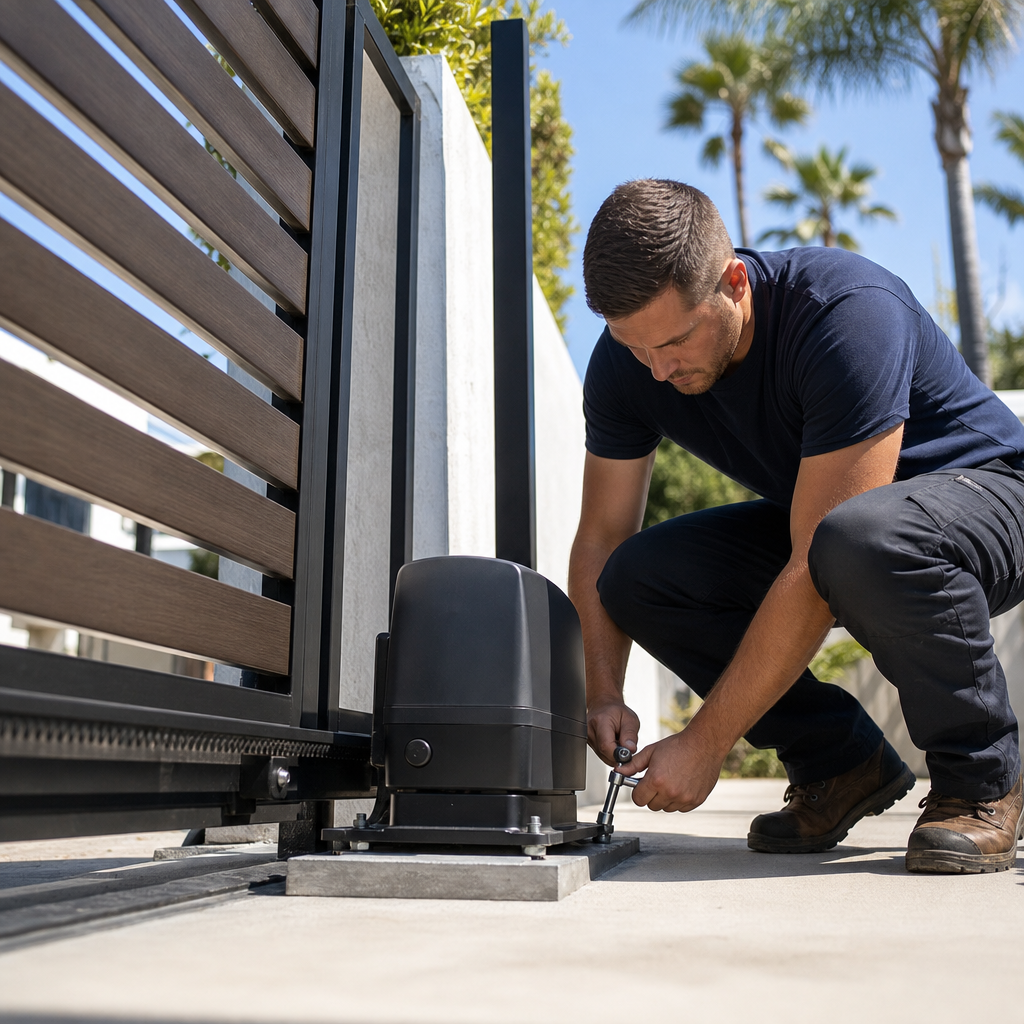
Driveway gates operate outdoors in various weather conditions, and installers may suggest materials and hardware suited to local environments.
Corrosion Resistance in Coastal and Humid Zones
In coastal areas or humid environments, corrosion resistance is an important consideration noted by regional technicians like ASAP Gate Repair Santa Monica. Installers often recommend materials such as aluminum, galvanized steel, or protective coatings, as well as weather-resistant enclosures for electronic controls.
Wind and Gate Sizing
Solid gates can experience significant wind resistance. When selecting an automatic gate opener, gate size and surface exposure are typically considered alongside gate weight to ensure the motor can operate the gate effectively under local weather conditions.
Project Timelines: What to Expect
According to typical commercial estimates summarized in industry sources, a full automated gate project often takes two to four weeks, though these are general estimates rather than universal expectations. A typical estimated breakdown may include:
- Design and Permitting (1 to 2 weeks): Finalizing dimensions, selecting gate styles, and coordinating municipal requirements.
- Fabrication (1 to 3 weeks, concurrent): Fabricating or sourcing custom or prefabricated gate panels.
- Site Prep and Post Setting (2 to 4 days): Digging post holes and pouring footings.
- Physical Hanging and Setup (1 to 2 days): Mounting gate panels, setting the operator, connecting safety components, and programming controls.
Safety Standards and Considerations
Automated gate installations require careful attention to physical safeguards and industry safety standards.
Safety Safeguards and Protections
Research supports attention to key safety measures, including:
- Pedestrian separation from vehicular gate openings.
- Protected openings and guards against entrapment or pinch points.
- Fall-over protection and safeguards against derailment or collapse.
- Positive stops for sliding gates to prevent over-travel.
- Warning signs placed in visible locations.
- Safe access-control placement located away from moving gate parts.
Electrical Safety
Electric gate opener installations should comply with applicable local electrical standards, with wiring properly protected and installed to provide safe operation.
Frequently Asked Questions
Do driveway gate installers set up automatic openers and intercom systems?
Many installers commonly handle both the gate structure and access automation. They may install electric gate operators, program wireless remotes, connect safety sensors, and integrate intercoms, keypads, or cellular access devices.
What qualifications and licenses should a driveway gate installer have?
Licensing and credential requirements depend on the jurisdiction and require local verification. In many areas, property owners may check whether a contractor holds appropriate trade or specialty licensing, liability insurance, or electrical credentials as recommended by local regulations.
Can an existing manual gate be converted to an automatic system?
In many cases, yes. A contractor can evaluate existing posts, hardware, and gate balance. If the structure is sound and moves freely by hand, an electric operator, safety sensors, and power connections may be added. If posts or frames are damaged, repairs or replacement may be necessary first.
What is the difference between custom gate fabrication and standard gate installation?
Standard installations use pre-manufactured panels in fixed widths (such as 12, 14, or 16 feet) and standard heights. Custom fabrication involves building the gate from scratch to match specific architectural designs, uneven driveway grades, non-standard driveway widths, and custom security requirements.
How often does an automated driveway gate require maintenance?
General manufacturer or contractor recommendations often suggest inspecting and servicing automated gates once or twice per year, though specific maintenance schedules require verification based on equipment guidelines and local environmental conditions. Routine service commonly includes checking hardware, testing safety sensors, and inspecting control enclosures.
Working with an experienced local gate installer such as ASAP Gate Repair Santa Monica helps ensure your gate functions reliably and safely for daily use.
Need what does a driveway gate installer near me do?
We’re available now – call for a fast, free estimate.
Sources
- Occupational projections and worker characteristics – bls.gov (2081)
- Data for Occupations Not Covered in Detail – bls.gov (2025)
- newresconst_auto_text – Census.gov – census.gov (2025)
- Fence erectors – trustined.org (2035)
- Fence Erectors: Salary, Outlook & Training 2026 | Trade Schools Directory – tradecolleges.org (2035)
Related reading: Why Hire Local Fence and Gate Companies Near Me – 10% Off & Free Estimate – Same-Day Service
Related reading: Automatic Driveway Gate Installers Near Me Cost Comparison | Call Now-10% Off | Same-Day Service | Free Estimate
Related reading: Comparing Commercial Fence and Gate Companies Near Me | 10% Off & Free Estimate | Same-Day Service
Frequently Asked Questions
What happens during a professional on-site driveway gate consultation?
An installer evaluates driveway topography, measures precise clearances, checks electrical access, and reviews access control options. Specialists like ASAP Gate Repair Santa Monica also assess ground stability and municipal setback rules to provide an accurate upfront estimate and custom installation plan.
How do driveway gate installers run electrical power to an automated gate operator?
Installers coordinate power by trenching underground conduit from your property main electrical panel to the gate operator location. If trenching is impractical or costly, professionals can install a solar-powered system with dedicated battery backups to reliably operate the motor and safety accessories.
How do professional installers protect automated driveway gates from coastal salt air and weather damage?
Installers specify corrosion-resistant materials like marine-grade aluminum or galvanized steel, along with sealed NEMA-rated enclosures for sensitive electronics. Drawing on eighteen years of local coastal experience, ASAP Gate Repair Santa Monica utilizes stainless-steel hardware and sealed bearing hinges to prevent rust and mechanical binding.
About the author
 |
Emily Stanton Emily Stanton is a technical writer specializing in home security and automated access systems. With over eight years of experience working alongside contractors and engineers in Southern California, she translates complex mechanical concepts into actionable advice for property owners. She holds a Bachelor of Arts in Communications from California State University, Northridge, and frequently covers residential security innovations and preventative maintenance strategies. |