Quick Summary
Preparing for a driveway gate installer near me visit requires reviewing property boundaries, municipal permit requirements, electrical capacity, and driveway slope to ensure an accurate site assessment. Specialists at ASAP Gate Repair Santa Monica emphasize that marking underground utilities, testing Wi-Fi range, and choosing durable materials in advance will streamline the consultation and prevent unexpected structural adjustments. Armed with these practical preparation steps, homeowners can confidently evaluate project estimates and contact ASAP Gate Repair Santa Monica to schedule a free onsite installation consultation.
Preparing for a Driveway Gate Installer Near Me Visit
When preparing for a driveway gate installer near me visit, the initial consultation generally includes a site walk, measurements, document review, and a discussion of design, access, drainage, utilities, and permitting needs. Most consultations take 30 to 60 minutes, though properties with complex site conditions, electrical considerations, or municipal setbacks can take longer.
An on-site gate evaluation allows the installer to assess driveway slope, conduit paths, electrical capacity, and environmental exposure. Having your details and documentation ready helps the technician, such as a specialist from ASAP Gate Repair Santa Monica, evaluate the site and produce an accurate estimate. See also Best Driveway Gate Contractors Near Me | 10% Off & Free Estimate | Same-Day Service.
What You Need Before a Driveway Gate Consultation
What to prepare in brief: Locate property boundary information, mark known utility lines, identify your electrical panel location, check your Wi-Fi signal at the gate line, and determine whether you prefer a swing or slide gate. Having HOA design guidelines and a clear budget ready will keep the consultation focused and productive.[4]
Preparing for a driveway gate installation consultation means addressing logistics before the contractor arrives on site. Reviewing these factors ahead of time helps prevent unexpected trenching or structural design changes later.
Quick Checklist for Your Site Assessment
- Site-Walk Review: Walk the proposed gate line to spot boundary pins, easements, underground drainage pipes, irrigation heads, and areas that heavy equipment must avoid.
- Safety Preparation: Identify whether the gate will swing or slide, clear the travel area, and inspect nearby posts, walls, landscaping, fence openings, and pedestrian areas. Ask the installer to identify every entrapment zone and specify the protection methods.
- Permit and Code Checks: Contact your local code official to determine whether building, electrical, zoning, right-of-way, or other permits apply to your gate installation.
- Pre-Construction Plan Review: Gather any existing plot plans, architectural drawings, or HOA compliance requirements for the installer to inspect.
Key Takeaways at a Glance
Assembling your property documents and requesting an itemized written estimate protects your investment. Confirm the operator’s electrical requirements with your installer, and verify whether backup power is provided and safety devices remain functional during battery operation.[3]
Step 1: Verify Property Lines, Setbacks, and Municipal Permits
Before meeting with a gate specialist, review your property lines and local setback requirements. Placing gate posts or footings over a boundary line can trigger costly disputes and relocation.
Locating Boundary Markers and Easements
Walking the site with your contractor helps identify property limits, access easements, utilities, drainage paths, and vegetation. A professional boundary survey may be warranted when property boundaries, easements, or rights-of-way are uncertain.[5]
Navigating Permitting and Local Regulations
Contact your local code official to determine whether building, electrical, zoning, right-of-way, or other permits apply to your gate installation. Required inspections and certifications depend on local rules and should be confirmed with the contractor or local authority.[1]
Step 2: Audit Electrical Capacity and Utility Locations
Automated gate operators require appropriate electrical power to operate reliably and safely.
Evaluating Power and Breaker Capacity
Ask your installer about the specific voltage and circuit requirements for the proposed operator. Inspect your main electrical panel to see if there is available space, and let the installer know if the panel is near capacity so they can discuss options during the site evaluation.
Assessing Underground Conduit Paths
Trace the physical route from your electrical source to the gate entrance, noting any crossings over driveways, walkways, or landscape beds. Ask your installer what conduit type and burial depths are appropriate or required by local codes for your site conditions.
Pro Tip: Call 811 to mark public underground utilities before your consultation. Knowing where utility lines run helps the installer plan footing depths and post locations safely.
Step 3: Test Perimeter Wi-Fi and Select Access Controls
Need preparing for a driveway gate installer near me visit?
We’re available now – call for a fast, free estimate.
Modern driveway gates often use communication networks for smart openers, telephone entry systems, video intercoms, and keypads.
Testing Signal Reach at the Curb
Stand at the planned gate location with your smartphone and check your home Wi-Fi signal. If the signal is weak, discuss communication options with your installer, such as hardwired data lines, wireless extenders, or cellular access controls.
Selecting Access Hardware Preferences
- Primary Entry Devices: Ask about entry options such as digital keypads, RFID readers, wireless remotes, or other access systems.
- Safety and Emergency Access: Ask how the operator handles emergency vehicle access, entrapment protection sensors, and battery backup operation during power outages.
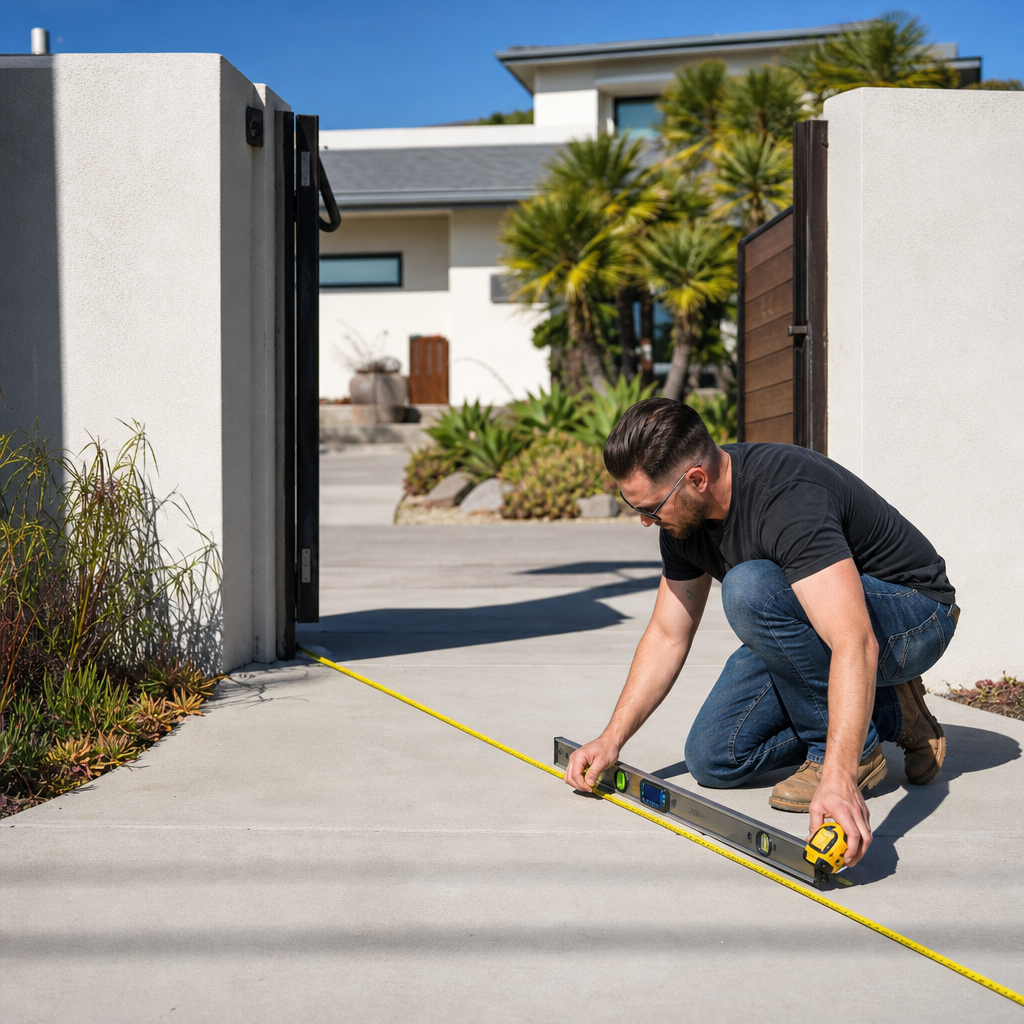
Step 4: Measure Clearances, Driveway Slope, and Physical Obstacles
Driveway grade and available clearance help determine what style of gate will function on your property.
Swing Gates vs. Slide Gates
Swing gates require level ground throughout their opening arc or specialized hinge arrangements if opening into a slope. Sliding gates travel horizontally along the fence line, requiring unobstructed clearance along the fence line for the gate panel and counterbalance extension. Ask your installer to evaluate your specific driveway grade and clearance requirements.
| Gate Style | Space Considerations | Typical Applications | Points to Discuss with Installer |
|---|---|---|---|
| Single Swing | Arc depth matching leaf width | Narrow openings, level ground | Slope clearance and hinge options |
| Dual Swing (Bi-Parting) | Arc depth for half the total opening | Wider entrances | Dual operator synchronization |
| Cantilever Slide | Driveway width plus counterbalance space | Sloped or uneven entryways | Total linear fence clearance needed |
| Track Slide | Driveway width plus operator setback | Compact properties | Ground track maintenance and debris exposure |
Step 5: Select Materials Engineered for Environmental Durability
Local environmental conditions influence the longevity of your gate frame, hardware, and finish.
Comparing Gate Materials
In coastal or humid environments, ask your installer, such as ASAP Gate Repair Santa Monica, about corrosion-resistant materials such as aluminum or galvanized steel with durable protective coatings. If considering wood gates, discuss the structural and motor requirements needed to support panel weight and wind loads.
Hardware and Operator Durability
Ask the installer to specify appropriate hinges, rollers, and weather-sealed operator enclosures designed for your local climate and exposure conditions.
Step 6: Questions to Ask During Your Gate Consultation
A reputable gate contractor will welcome technical questions about code compliance, safety ratings, and warranty terms. Bring these questions to your on-site meeting:
- Safety Standards: How will the installation comply with applicable safety standards, such as UL 325 and ASTM F2200? (Applicable UL 325 and ASTM F2200 requirements, as well as the relevant edition and local code rules, should be verified at the time of installation.)
- Entrapment Protection: Can you identify every potential entrapment zone and specify the protection methods for each?
- Permits and Inspections: Who will be responsible in writing for pulling required permits, submitting plans, and scheduling inspections?
- Electrical and Backup Power: What are the operator’s electrical requirements, is battery backup provided, and will safety devices remain functional during battery operation?
- Itemized Quote: Can you provide a detailed quote that separates the costs of the gate, operator system, footings, trenching, electrical work, and labor?
- Warranty Coverage: What are the warranty terms for the structure, operator, electronics, and installation labor?
Frequently Asked Questions
How long does an on-site driveway gate consultation take?
A standard consultation generally takes 30 to 60 minutes. The initial visit typically involves a site walk, measurements, document review, and a discussion of design, access, drainage, utilities, and permitting needs.
Do I need a property survey before the gate installer arrives?
A property survey is not always required for an initial consultation, but a survey may be warranted when property boundaries, easements, or rights-of-way are uncertain to avoid encroaching on neighboring parcels or public easements.
Who is responsible for pulling gate installation permits?
Permit responsibilities vary by jurisdiction and contractor agreement. Confirm in writing who is responsible for permit applications, inspections, and certifications. Required inspections and certifications depend on local rules and should be confirmed with the contractor or local authority.[2]
Can I install an automated gate on a sloped driveway?
Yes. Sloped driveways often utilize slide or cantilever gate configurations that travel along the fence line. If a swing gate is preferred, discuss specialized uphill hinges or opening configurations with your installer, such as ASAP Gate Repair Santa Monica, to ensure compatibility with your site and local codes.
Need preparing for a driveway gate installer near me visit?
We’re available now – call for a fast, free estimate.
Sources
- Building Codes Toolkit – fema.gov (2023)
- Hiring A Contractor – City of Hamilton, OH – hamilton-oh.gov
- Permitting | Code Enforcement – Mecklenburg County Government – code.mecknc.gov
- Guide to Residential Permits and Inspections – portland.gov
- Understanding Each Participant’s Role – fairfaxcounty.gov
Related reading: What Does a Driveway Gate Installer Near Me Do | 10% Off & Free Estimate | Same-Day Service
Related reading: When to Call Commercial Fence and Gate Companies Near Me | 10% Off & Free Estimate | Same-Day Service
Related reading: Role of Automatic Driveway Gate Installers Near Me – 10% Off & Free Estimate – Same-Day Service
Frequently Asked Questions
How far in advance should I call 811 before my driveway gate consultation?
You should contact 811 at least two to three business days before your appointment so local utility providers have adequate time to mark underground lines. Technicians from ASAP Gate Repair Santa Monica rely on these markings during the site walk to safely plan footing depths, trenching routes, and post anchors.
What access control alternatives work best if my home Wi-Fi does not reach the gate?
If standard Wi-Fi coverage falls short at your property boundary, installers typically recommend hardwired Ethernet conduits, long-range wireless bridge extenders, or cellular-based intercom systems. Specialists at ASAP Gate Repair Santa Monica can evaluate your signal strength on-site and specify the most reliable network hardware for your entrance.
What safety features are required to meet UL 325 standards on an automated driveway gate?
Automated residential gates must incorporate both primary and secondary entrapment protection devices, such as monitored photo-eye sensors, reversing edges, and emergency release mechanisms. During your consultation, ASAP Gate Repair Santa Monica inspects potential pinch points along the gate line to ensure your layout strictly adheres to current UL 325 and ASTM F2200 safety mandates.
About the author
 |
Emily Stanton Emily Stanton is a technical writer specializing in home security and automated access systems. With over eight years of experience working alongside contractors and engineers in Southern California, she translates complex mechanical concepts into actionable advice for property owners. She holds a Bachelor of Arts in Communications from California State University, Northridge, and frequently covers residential security innovations and preventative maintenance strategies. |